The decision to get a divorce is a very difficult one no matter where you live or what the circumstances.

But while some may think the decision itself is the hardest part of the divorce process, the choice of using divorce mediation vs a lawyer can be an even more challenging one if you don’t know the differences between the two.

With a little education, you can make the decision that’s right for you in your situation.

Divorce mediator vs lawyer

Before we cover some of the key differences in between using a divorce mediator vs attorney, here’s a high-level overview of how each of these divorce options work:

What is a lawyer’s role?

A lawyer’s role is to advocate for the one party that hired them with the goal of achieving the most favorable outcome for their one client. A lawyer can only represent one party.

Traditional divorce litigation:

Illustration of a divorcing couple seated before a judge and attorneys in a courtroom, highlighting the adversarial nature of litigation. Prefer a peaceful alternative? Call Equitable Mediation at (877) 732-6682 to explore mediation that keeps you in control and out of court.

There are many steps involved in a litigated divorce with lawyers and the steps vary from state-to-state, county-to county and couple-to-couple.

But at a very high level, in a standard lawyer divorce, each divorcing spouse hires their own lawyer to help them complete the steps required for divorce, and to advocate for their legal rights on their behalf.

The two lawyers will enter into negotiations on behalf of their clients regarding the issues.

For the sole purpose of describing a lawyer-driven divorce as simplistically as possible, I’m going to use a fictitious couple where Jen is the wife and Mike is the husband.

We are assuming that Jen and Mike are being reasonable and that each lawyer is being reasonable, though it is common for an attorney-driven divorce to escalate into something less cooperative.

So, here’s how it begins:

  • Jen’s lawyer files paperwork with the court requesting a divorce on behalf of her client.
  • Mike is then notified usually by mail, but it sometimes happens in person, that Jen wants a divorce.
  • Each spouse meets with their divorce lawyer to identify the relevant issues to their case and provide them with a high-level overview of what it is they’re looking to get in the divorce.
  • In parallel, each spouse’s lawyer also requests personal and financial information related to the case from the other side.
  • At this point, Jen’s lawyer will give her advice on what they think Jen should ask for, and what the terms of the divorce settlement might be if decided by a judge.
  • Jen may or may not agree with her lawyer’s advice because remember – ultimately, it’s up to Jen to decide what it is she wants to do.
  • Jen tells her lawyer what she wants the settlement to look like regarding property and asset division, parenting and time sharing, child support, and alimony, as well as other conditions of the divorce.
  • Jen’s lawyer sends a letter to Mike’s lawyer outlining Jen’s proposed settlement terms.
  • Mike’s lawyer discusses the proposed terms with Mike. Mike’s lawyer gives Mike advice on what he thinks he should take, not agree to, agree to. Mike may or may not agree with his lawyer’s advice.
  • Mike decides whether or not he agrees with any/or all of the proposed terms.
  • The spouses’ lawyers then go back and forth until all terms are agreed to by both sides. This can take weeks, months, or even years, depending on how cooperative or difficult the spouses – and their lawyers – want to be throughout the legal proceedings.

Once both spouses agree, Jen’s lawyer then goes ahead and drafts the settlement agreement, files more paperwork with the courts, and requests a court date and final hearing.

If agreement cannot be reached on one or more of the issues using this approach, the divorce will carry on through the family court system.

A court date will be set. And each divorce attorney along with the party that hired them will prepare their case. In contested divorces, documents will be presented to the court throughout the divorce trial. Arguments will be made regarding the merits of positions. Witnesses or outside experts will be brought in to court to testify. The couple’s children may even be called to the stand during litigation.

All of this transpires in court in front of a family law judge who will ultimately decide the outcome regarding parenting time, child custody, child support, alimony and division of marital assets and debts. These are what is known as contested divorces.

Divorce mediation process: What is a mediator and what is the mediator’s role?

Illustration of a mediator guiding a couple through each step of divorce mediation—from initial intake to agreement signing—using a whiteboard and supportive gestures. Want to understand how mediation works for your situation? Call Equitable Mediation at (877) 732-6682 to learn more today.

Divorce mediation is a dynamic alternative dispute resolution process. And a divorce mediator acts as an independent, neutral third-party who conducts mediation proceedings.

Mediators help parties involved in a conflict or dispute come to a mutual agreement.

For a divorcing couple, the divorce itself is the dispute and the mediator’s role is to help both spouses identify, negotiate and come to mutually-acceptable agreement on the various issues and financial matters required for divorce. In a mediation session, the divorce mediator actively participates in the negotiations, but the two spouses have full control over the divorce agreement and decisions they will be making.

There are a number of skills a divorce mediator must possess in order to make them highly-skilled.

First, a highly-skilled mediator must have extensive knowledge on a wide variety of topics ranging from parenting and time sharing, child support, alimony, and the distribution of martial property and debts. And do so specifically for the state in which a couple lives – or is filing for divorce.

But just knowing about these topics isn’t enough to be a highly-skilled mediator! A mediator also needs to be able to use that knowledge to facilitate, and actively engage a couple in, a series of discussions surrounding the necessary issues to be resolved in their divorce.

The mediator must not only listen to each spouse’s wants, needs, concerns, and goals, but help formulate ideas, bring options to the table, and work with them to develop fair and equitable solutions which are in both their best interests.

The ultimate goal of the mediator is to help couples come to mutually acceptable agreements – on all of the required issues – to peacefully end their marriage out of court.

Now, if they don’t agree on a particular topic, a highly skilled mediator will have – and use – a variety of advanced conflict resolution techniques to help them communicate, understand each other’s interests, and negotiate the areas of disagreement.

Once the mediator has assisted the divorcing couple in reaching all necessary agreements, they now need to be able to expertly draft those agreements into a comprehensive memorandum of understanding. As well as prepare a host of other supporting paperwork.

Since by its very nature, divorce is a conflict between two people, guiding a divorcing couple to mutually beneficial agreement is not as easy as one might think!

But ultimately, divorce mediation helps couples avoid the trauma and emotional stress that often results from more contentious divorce methods.

Finally, it’s important to note that while some mediators meet with clients in-person, others practice divorce mediation online, delivering mediation services to clients via telephone and screen-sharing software or video conferencing software. This type of mediation should not be confused with an Internet (or online) divorce, because they are two different things.

Online mediation is actual divorce mediation, but simply conducted in an online format.

Is a mediator a lawyer?

Mediation is a skillset unto itself and is also an unregulated field. So a mediator can be a family law attorney or a non-attorney (financial professional, mental health professional, etc.).

It is common for a divorce attorney or retired judge to feel that attending law school provides them the skills they need in order to practice mediation, so you will find that there are a number of divorce mediation attorneys out there. But while they may have a grasp of divorce law, they may or may not know how to be an effective, neutral mediator. Lawyers also may not have the financial acumen required to negotiate agreements on the many complex fiscal matters surrounding divorce.

The best mediators have been professionally trained in mediation, are fully neutral, know the divorce issues, and are also experts in resolving the complex financial matters surrounding the divorce.

There is no requirement that a mediator be a lawyer and in fact, some of the most qualified mediators aren’t lawyers at all.

Additionally, when a couple uses divorce mediation, lawyers are not also required at any point in their uncontested divorce unless either/both spouses choose to involve them.

That makes mediating a good option for those who wish to resolve divorce issues without lawyers, without court and without litigation.

INFO CALL

Weighing mediation vs. hiring attorneys? Let’s talk about how mediation keeps you in control, saves money, and helps you both reach solutions faster.

To schedule an info call, please complete the form and choose a date and time.

Immediately after you submit the questionnaire, you will be re-directed to a page that includes a link to Cheryl’s calendar. View availability and select a date/time that works for you.

Important Information:

  • To ensure everyone’s time is respected, we ask for at least 72 hours’ notice for any scheduling changes.
  • If you are looking for legal advice, DO NOT book this call. Cheryl is not a lawyer and cannot and will not provide legal advice.
  • If you are in the midst of a divorce and one or both of you have hired lawyers, and you wish to learn more about your options, you MUST book an Initial Meeting with Joe.

Collaborative divorce:

Flowchart-style graphic illustrating the collaborative law process steps—initial consultation, signed participation agreements, joint meetings with attorneys, and final settlement—branded with Equitable Mediation’s logo. Curious how collaborative law can work for you? Call Equitable Mediation at (877) 732-6682 to learn more today.

The collaborative law process (also referred to as collaborative divorce, collaborative process or collaborative divorce process) is an alternative dispute resolution method that is a cross between lawyer-driven divorce litigation and divorce mediation.

To learn more about the differences between these two divorce methods, read collaborative divorce process vs mediation process.

To learn more about how each of these three divorce options work, read: The 5 divorce options and how to choose the right one for you.

Differences between using a divorce mediator vs lawyer for a divorce:
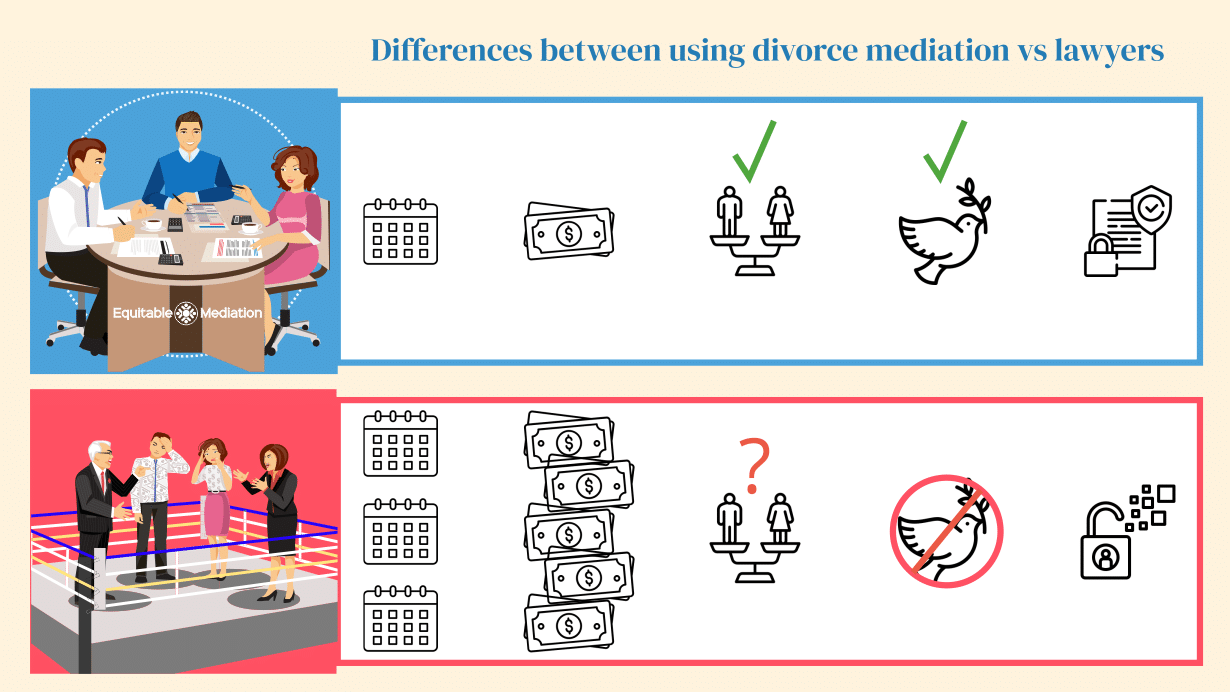
Number of professionals

  • In divorce mediation, there is 1 mediator vs. 2 lawyers for divorce (one lawyer per spouse.)

Premise

  • A lawyer can only represent one spouse and their job is to advocate for their one client.
  • A mediator is a neutral third party and doesn’t take sides – in divorce mediation, they help both spouses negotiate and reach an agreement best for them and their children.

Approach

  • Lawyers give legal advice and advise their clients on what to do.
  • Mediators do not dispense legal advice. Instead, the divorcing couple has full control over making their own decisions.

Time to Completion

  • A lawyer-driven divorce can take 18 months to 3 years to complete.
  • A mediated divorce can take 3 to 6 months to complete (2 to 5 mediation sessions) and the speed of the process is in large part directed by the spouses.

Once mediation is completed, the speed of the divorce process is related to the time it takes to file and complete the divorce through the courts.

Cost

  • According to FindLaw, the median cost of a divorce lawyer is $10,000+ per spouse. Which means the average cost of a traditional lawyer-driven divorce starts at $20,000 per couple.
  • While the cost of a lawyer-led collaborative divorce can range from $25,000 to $50,000 per couple.
  • And if a divorce goes to trial, it can range from $78,000 to $200,000 per couple.
  • The total cost of a mediated divorce can range from $6,000 to $10,000 and depends on the experience and skill level of the mediator, the scope of services they include, a couple’s specific case complexities and conflict level, and the state where the divorce is taking place.

Certainty of outcome

  • A lawyer-driven litigated divorce is risky because there are no guarantees as to which side of any issue a judge is going to rule in court. Some lawyers use strategies to confuse, manipulate or outsmart their opposition. Every lawyer has their own style and personality. Some family law attorneys can be hostile and deceptive; others can be irrational.

So if you hire a divorce lawyer who is unreasonable or incompetent, you could find yourself with an unfavorable case outcome. And if your court case ever goes to trial and the judge makes their decision, you could find that you’re not satisfied with the ruling in your divorce matter.

  • In private mediation, since both spouses have a direct say in outlining the terms of their agreement, dispute resolution outcomes are certain with respect to the couple’s parenting plan arrangement, child custody and child support, spousal support, property division and all other issues that must be resolved in their divorce.

Peaceful

  • A lawyer-driven divorce, especially litigation, is an adversarial process and not peaceful in any way.
  • The divorce mediation process is non-adversarial and cooperative so mediation is more peaceful.

Confidentiality

  • A divorce litigation is a matter of public record.
  • Mediation is a private process and its contents confidential.

Mediation vs divorce lawyer: Which should you choose?

Couple consulting with a mediator at a table, pointing at a calendar to determine the right time to begin mediation. Wondering when to choose a divorce mediator? Call Equitable Mediation at (877) 732-6682 for personalized advice and timing guidance today.

Here are some good reasons to choose mediation vs lawyers for divorce.

1. You want what’s best for your children.

Far and away, this is first on the list of the many benefits of divorce mediation. As a parent, you already know that divorce is tough on you.

But it’s even tougher on your kids.

So by discussing the issues as parents, instead of litigants in some drawn out court battle, you can outline the terms of your settlement agreement including time sharing and child support so that they are focused on what’s truly best for your children.

2. You want to keep things peaceful.

Even happily married couples argue occasionally, so it’s no surprise that divorcing spouses fight. But you don’t need to agree on everything or be the best of friends in order to mediate.

If you and your soon-to-be ex are both willing to attend mediation, you can have a successful family mediation. And you can more peacefully divorce and preserve your emotional well being.

3. You want to save money.

Retainers range from $5,000 to $10,000 per person. So if you work with lawyers, right off the bat you’re looking at spending a minimum of $10,000 to $20,000 on legal fees for your divorce case. And everyone knows that’s just the beginning. The cost of divorce only goes up from there, especially in contentious cases where there’s disagreement on any of the issues.

But if you use mediation, you can save thousands on your divorce.

4. You don’t want your divorce proceedings to drag on forever.

When you look at the choice of a divorce mediator vs attorney, mediated divorces take significantly less time. Divorces that are handled by attorneys take longer, in part, because of the back and forth nature of communications that happen between opposing counsel.

Instead of waiting to talk to your lawyer about a topic of disagreement and then waiting for your lawyer to write a letter to the other side and then waiting for a response, in mediation, all communications take place in real time so any disagreements can be discussed and resolved right then and there.

If you want to complete your divorce in a lot less time, mediation is the way to go.

5. You want a high level of control over your divorce agreement.

Mediation allows you and your husband or wife to discuss and resolve all issues that pertain to your particular situation. And your agreement can also be customized to your specific needs.

The two of you will be fully empowered to make educated decisions that are right for you. And your divorce settlement will be fair to both of you because you’ll both have direct input into crafting its terms and conditions.

Use a divorce lawyer vs mediator when:
1. Your spouse is incapacitated.

Mediation is all about “self-determination” and the parties’ abilities to make decisions that are in their own best self-interests.

But what if you have doubts about your spouse’s ability to do that?

Perhaps they’re an addict or are living with a neurological condition such as Alzheimer’s disease. Or for some other reason, they do not have the ability to make sound decisions.

If they’re mentally incapacitated in any way, they’ll need an advocate and should get a family law attorney.

2. You fear for your safety or there’s domestic violence.

If there’s a restraining order in effect, it may make mediating impossible.

Or maybe there’s such a significant power imbalance that you are afraid to express your true needs for fear of retribution from the other side.

Your safety should be your number one concern, so if you are afraid for your safety, you’ll want to get an attorney instead of using mediation.

3. You have reason to believe your spouse is hiding assets.

Mediation is a good faith negotiation and requires transparency.

So if you have evidence that your husband or wife is hiding assets or debts from you, or their business dealings aren’t above bar, choose a lawyer vs a mediator.

Lawyers can file motions with the courts to compel your spouse to surrender the necessary documentation needed to see if, in fact, there is an issue.

4. Your spouse is unwilling to mediate.

Because mediation is a voluntary process, both of you must be willing to at least give it a try. Active participation by both spouses is one of the requirements to make mediation work.

If you want to mediate but your spouse refuses to cooperate, in cases of contested divorces, you’ll need to find another divorce method.

Divorce mediator vs attorney for divorce?

As you can see, the question of whether to use a lawyer vs mediator is one that solely depends on your unique situation. But if you want to divorce amicably and do what’s best for your children while saving money and time in the process, and your spouse is willing to do the same, get a mediator vs divorce lawyer.

You’ll be glad you did!

Frequently Asked Questions

Mediation is an unregulated profession in the United States, and every mediator has their own approach. We can only speak to how divorce mediation works with us.

Strategy Session

Our mediation process starts with a strategy meeting – the first meeting between you, your spouse, and Joe, your mediator, to set goals and develop the plan for your negotiations. During this meeting, he will share what you can expect throughout the process and tips for how to get an optimal outcome. You and your spouse will each have the opportunity to voice your most pressing concerns and goals for mediation.

Joe will then work with you both to develop a tailored plan for addressing each issue throughout your negotiations, determining the most effective sequence for resolving matters regarding your children, finances, property, and future.

Having a complete financial picture allows Joe to understand your situation and create options to explore during negotiations that best serve your family’s needs. At the end of the strategy session, Joe will walk you through what financial information is needed prior to each mediation session.

Mediation Sessions

After completing your initial financial work, you’ll schedule your first session. During this and subsequent meetings as needed, Joe will help you work through and resolve all necessary aspects of your divorce including a parenting plan, child support, alimony, and division of property and debts.

He will listen to each of your wants, needs, concerns, and goals, formulate ideas, create options, and work together with you to develop fair and equitable solutions. Drawing on his financial expertise, he’ll provide guidance about the financial matters relating to your divorce so you know what your financial picture will look like moving forward.

In areas where agreement proves challenging, Joe will employ various conflict resolution techniques to help you and your spouse communicate more effectively, understand each other’s interests, and negotiate toward mutually agreeable solutions.

After each session, Joe will outline specific tasks to prepare for your next meeting – whether that’s gathering financial documents or considering options discussed. This step-by-step approach keeps the process manageable and productive. You can easily submit all documents through our secure online portal.

Drafting of the Agreement

Once all necessary issues have been resolved and your negotiations have concluded, Joe will draft a comprehensive document called a Memorandum of Understanding detailing all agreements, along with a host of other supporting documents. This paperwork will outline the terms of your divorce.

Mediation can resolve all of the issues necessary for a couple’s divorce including, but not limited to:

  • parenting plan outlining parental responsibilities and time sharing arrangements for co-parenting children post-divorce. (some refer to this as custody)
  • Child support(which is the financial support each parent will provide the children)
  • The division of marital assets and liabilities. (also referred to as either equitable distribution or community property, depending on the state where the divorce is taking place)
  • And how much, and for how long alimony will be paid or received. (alimony may also be referred to as either spousal support, maintenance, or spousal maintenance, depending on the state where the couple is getting a divorce)

Along with the four main issues listed above, mediation can help resolve a host of other important issues related to your unique situation or circumstances.

Every mediator’s process (if they have one) is different, so we can only speak to how long divorce mediation takes working with us.

Most couples complete their mediation in 3 – 5 sessions, meeting with Joe every other week. On average, divorce mediation takes 2 – 3 months. The speed of our divorce mediation process is largely within your control. Your timeline will depend on the complexities of your case, how quickly you complete the required financial work between sessions, ease in coordinating your schedules, and pace in reaching decisions.

Every private mediator has their own fee structure, and divorce mediation cost and fees vary significantly based on the experience and skill level of the mediator, the scope of their mediation services and individual case complexities. They also vary from state-to-state.

Our mediation fees are tailored to each couple’s unique situation and case complexity. Even our most comprehensive packages typically cost less than what you’d spend on two attorney retainers.

Our sessions take place via Zoom. Online mediation provides a flexible, convenient and efficient dispute resolution solution. In fact, we pioneered online divorce mediation and have been successfully mediating in this format since 2011.

There is no legal requirement that you must have a divorce attorney, and many people specifically choose mediation because they want to divorce without a lawyer. However, depending on their professional background and approach, some mediators do require each spouse to hire a lawyer to consult with throughout mediation.

While attorney consultation is not required in our mediation process, we fully support clients who wish to seek legal counsel at any stage. Our focus is on empowering you to make informed decisions in whatever way works best for your situation.

No! You do not need to have everything decided before starting mediation. The only thing you need to agree on is the decision itself to mediate your divorce. In fact, many couples specifically wait until mediation to negotiate the issues.

Divorce is a complex matter, and you may not “know what you don’t know” when it comes to the issues you need to identify, discuss and resolve in order to come to a complete agreement. By working with Joe, you can be assured that everything will be discussed thoroughly – in the proper order and given the necessary time and attention it deserves.

Whether you are divorcing or separating, our mediation process is the same. The difference is in what you choose to do with your mediation agreement after the process is completed.

Starting mediation with us begins with a simple first step – scheduling an initial meeting for you and your spouse. This meeting gives you a chance to share your situation, ask questions, and learn about our mediation process in a private, no-pressure setting. It also helps us understand how we can best support your unique needs.

** Available to couples whose divorce or separation will take place in California, Illinois, New Jersey, New York, Pennsylvania, or Washington State.

You and your children will benefit when you choose divorce mediation.

Mediation is more Peaceful: A mediator guides couples to attack problems, not each other – fostering respectful dialog and win-win solutions. This approach paves the way for a peaceful, amicable divorce that benefits both spouses and their children.

Fair and Equitable: One party cannot “win” at the expense of the other as resolutions must emerge from the process with a divorce settlement created and acceptable to both parties.

Less Expensive: The cost of divorce mediation is significantly less than traditional divorce litigation, the collaborative divorce process, or a court trial.

Better for Children: Children aren’t caught in the middle of a confrontational family court process or traumatic heated custody battle. Instead, parents work together to resolve the issues in a way that’s best for their family. A non-adversarial approach fosters more agreement, improved communication, better parenting plans and a better co-parenting relationship.

Better Results: Couples who mediate are more satisfied with the terms of their divorce because they were mutually agreed upon.

Dignified: Instead of the cold, traditional court process where a couple is treated like a case file or docket number, mediation is a kinder, more human process. Divorce mediation allows couples to end their marriage while maintaining self-respect and dignity.

Private and Confidential: In a private mediation session, everything is confidential. No one will know what’s being discussed except the two spouses and their mediator. Unlike a litigated divorce, where everything submitted to the family law court is part of the public record.

Divorce Faster: The pace of the process is controlled by the parties, instead of being at the mercy of a lawyer’s or a judge’s schedule.

Ultimately, the payment arrangement is up to the couple to decide together. Most frequently, couples split the mediation costs equally between them, as the mediator works with both spouses together to help them reach agreements. This 50-50 split often feels fair to most people since they each benefit from the process.

Another approach is to share mediation costs in a ratio based on each spouse’s income. For instance, if one spouse earns twice as much as the other, they might pay two-thirds of the cost while the lower-earning spouse pays one-third. This income-based split can make mediation more accessible for couples with significant income differences. Occasionally, one spouse may choose to pay the entire cost of mediation, though this is less common.

No, a mediator cannot give legal advice. Some people think if they hire a divorce mediation attorney, which is another way of saying a lawyer who practices mediation, that the “attorney-mediator” can provide legal advice.

But that is not the case. Because when they are in the role of a divorce mediator, a lawyer cannot dispense legal advice – regardless of their professional background.

There’s a lot more to these divorce methods and how they work, but here are just a few of the many differences between divorce mediation vs a lawyer.

In attorney-driven divorces, each spouse hires their own respective attorney to represent them.

The two lawyers will argue back and forth in court on issues of child custody and a parenting plan, division of property, alimony and child support. Each divorce lawyer will create strategies to fight and weaken the other party’s position in order to “win” the divorce case for their respective client – even if it’s at the detriment of the other spouse, the couple’s children or the overall health of the family unit.

Traditional divorce litigation using attorneys is adversarial, lengthy, and expensive.

In divorce mediation, both spouses work with one mediator.

The divorce mediator does not take sides and does not give legal advice – they are a neutral third party. The mediator helps both spouses communicate, negotiate directly (privately and out of court) and resolve all issues that pertain to their divorce. Couples have the opportunity to voice their individual concerns, be heard and have direct input into the terms of their divorce settlement agreement.

In mediation, there is no “win-lose” as a skilled divorce mediator helps the couple reach fair and amicable solutions that prioritize the well-being of children. Mediation is a more peaceful, less costly, confidential divorce method that takes significantly less time and produces better outcomes.

There are many differences between divorce mediation and collaborative law including cost, time to complete and approach.

The Collaborative Law Process is a hybrid between a traditional attorney-led divorce and divorce mediation.

Each party retains their own respective lawyer trained in the collaborative process to represent them. Both spouses and their respective counsel sign a contract called a “participation agreement” that states that they are all committed to using cooperative techniques rather than combative tactics to resolve custody, support, etc.

In the Collaborative Process, a series of meetings take place between both spouses and both lawyers and possibly other outside professionals such as a divorce coach or therapist, child specialist, accountants or financial planners as needed to negotiate and try to come to agreement on the issues. If agreement cannot successfully be reached on all relevant divorce issues using the Collaborative Divorce Process, the lawyers will be disqualified from representing the two parties as they continue into the litigation process.

While for some problematic cases, Collaborative Process can be worth a try before resorting to divorce litigation, but it can get very expensive and drawn-out, and there are no guarantees of success.

In the process of mediation, there are three participants working together in direct negotiations: each spouse and one mediator.

The mediator is neutral and does not represent either spouse. They help the two parties negotiate directly to resolve all required issues pertaining to their divorce. Couples have direct input into the terms of their agreement. In mediation, there is no “us against them” as the goal of mediation is to help the parties reach an agreement they are both satisfied with and that keeps their children front and center.

Mediation delivers better outcomes for divorcing couples and their kids, takes less time to complete and is less expensive than a collaborative divorce.

Learn more about divorce mediator vs collaborative law.

During the negotiation phase of the process, mediation is not yet binding. But once all issues in your divorce are resolved and agreed upon, drafted into a proper document by a qualified professional, signed by both parties (both spouses), and approved by the courts, the agreements made will become binding in a couple’s divorce decree.

After a couple reaches agreement on all issues in mediation, the final step is completing the formal court process to end the marriage. However, the time to finalize a divorce after mediation varies significantly by state and sometimes even by county, as each jurisdiction has its own requirements.

For example, in New Jersey, there is no waiting period. The process simply requires the couple’s filing professional to submit the court paperwork and await a court date, which typically takes 8 to 12 weeks. In contrast, California has a mandatory 6-month waiting period. This means that even after completing all required paperwork, couples must wait an additional 6 months before receiving their final judgment of divorce.

Divorce mediation is a viable option for couples who meet all of the following criteria:

  • Couples who want an experienced professional to help them identify and discuss the issues while retaining full control over the decisions they will make and full control over their settlement agreement;

An experienced divorce mediator will help the parties identify the issues and present a number of possible solutions, but will not give the parties legal advice or tell either party what to do.

  • Couples who are willing to engage in an honest and good faith negotiation;

Mediation is a transparent process so both parties must be willing to openly disclose all relevant information, whether financial or otherwise, to the mediator and to the other party and ensure the information is accurate, complete and truthful to the best of their knowledge. If either party is hiding assets or defrauding the other, mediation should not be used.

  • Couples where both spouses are willing to voluntarily attend and actively participate in mediation;

If one party wants to mediate but the other does not, mediation will not be a viable option for that couple’s divorce.

  • Spouses who are both mentally capable of making their own decisions;

Each party must be of sound mind and have the capacity to think, reason and understand for him/herself. Learn who we help.

  • One spouse is incapacitated
    Mediation centers on “self-determination” – the ability of both parties to make decisions in their own best interests. If they’re mentally incapacitated in any way, mediation will not be a viable option.
  • There’s domestic violence or safety concerns
    If there’s a restraining order in effect, it may make mediating impossible. Or maybe there’s such a significant power imbalance that one spouse is afraid to express their true needs for fear of retribution from the other side. If a party has safety concerns, mediation will not be a viable option.
  • A party has concerns that assets or debts are being concealed.
    Mediation is a good faith negotiation and requires transparency. So if one party is concerned the other is hiding assets or debts, or their business dealings aren’t above bar, mediation is not recommended.
  • One spouse refuses to participate
    Because mediation is voluntary, both spouses must be willing to at least give it a try. Active participation is one of the requirements for making mediation work.

Divorce mediation is an unregulated profession and there’s no such thing as a certified mediator (other than a term some mediation associations designate to their members), so it’s also critically important to hire a good mediator.

There are four characteristics of an experienced and competent mediator for divorce:

  1. The ability to expertly guide two opposing parties through a complex negotiation and ultimately to settlement while remaining neutral at all times;
  2. The ability to create a series of settlement options for the parties to discuss and consider based on the mediator’s involvement with a variety of other cases similar to theirs;
  3. A command of the complex financial matters surrounding divorce;
  4. A comprehensive knowledge of and ability to remain current on the issues that may impact a couple’s divorce agreement.

Some attorneys feel that attending law school provides them with the skills they need in order to practice mediation. But while they may have a grasp of family law matters, they may not know how to be an effective mediator or remain fully neutral. They also may not have the financial acumen required to resolve the many complex financial issues surrounding a divorce dispute.

The key is to choose a mediator who has been professionally trained, knows the issues that need resolution, is truly neutral, has mediated hundreds of cases and is skilled in resolving the complex financial matters surrounding divorce.

Lay the groundwork for a peaceful divorce

About the Authors – Divorce Mediators You Can Trust

Equitable Mediation Services is a trusted and nationally recognized provider of divorce mediation, serving couples exclusively in California, New Jersey, Washington, New York, Illinois, and Pennsylvania. Founded in 2008, this husband-and-wife team has successfully guided more than 1,000 couples through the complex divorce process, helping them reach amicable, fair, and thorough agreements that balance each of their interests and prioritizes their children’s well-being. All without involving attorneys if they so choose.

At the heart of Equitable Mediation are Joe Dillon, MBA, and Cheryl Dillon, CPC—two compassionate, experienced professionals committed to helping couples resolve divorce’s financial, emotional, and practical issues peacefully and with dignity.

Photo of mediator Joe Dillon at the center of the Equitable Mediation team, all smiling and poised around a conference table ready to assist. Looking for expert, compassionate divorce support? Call Equitable Mediation at (877) 732-6682 to connect with our dedicated team today.

Joe Dillon, MBA – Divorce Mediator & Negotiation Expert

As a seasoned Divorce Mediator with an MBA in Finance, Joe Dillon specializes in helping clients navigate complex parental and financial issues, including:

  • Physical and legal custody
  • Spousal support (alimony) and child support
  • Equitable distribution and community property division
  • Business ownership
  • Retirement accounts, stock options, and RSUs

Joe’s unique blend of financial acumen, mediation expertise, and personal insight enables him to skillfully guide couples through complex divorce negotiations, reaching fair agreements that safeguard the family’s emotional and financial well-being.

He brings clarity and structure to even the most challenging negotiations, ensuring both parties feel heard, supported, and in control of their outcome. This approach has earned him a reputation as one of the most trusted names in alternative dispute resolution.

Photo of Cheryl Dillon standing with the Equitable Mediation team in a bright conference room, all smiling and ready to guide clients through an amicable divorce process. For compassionate, expert support from Cheryl Dillon and our team, call Equitable Mediation at (877) 732-6682 today.

Cheryl Dillon, CPC – Certified Divorce Coach & Life Transitions Expert

Cheryl Dillon is a Certified Professional Coach (CPC) and the Divorce Coach at Equitable Mediation. She earned a bachelor’s degree in psychology and completed formal training at The Institute for Professional Excellence in Coaching (iPEC) – an internationally recognized leader in the field of coaching education.

Her unique blend of emotional intelligence, coaching expertise, and personal insight enables her to guide individuals through divorce’s emotional complexities compassionately.

Cheryl’s approach fosters improved communication, reduced conflict, and better decision-making, equipping clients to manage divorce’s challenges effectively. Because emotions have a profound impact on shaping the divorce process, its outcomes, and future well-being of all involved.

What We Offer: Flat-Fee, Full-Service Divorce Mediation

Equitable Mediation provides:

  • Full-service divorce mediation with real financial expertise
  • Convenient, online sessions via Zoom
  • Unlimited sessions for one customized flat fee (no hourly billing surprises)
  • Child custody and parenting plan negotiation
  • Spousal support and asset division mediation
  • Divorce coaching and emotional support
  • Free and paid educational courses on the divorce process

Whether clients are facing financial complexities, looking to safeguard their children’s futures, or trying to protect everything they’ve worked hard to build, Equitable Mediation has the expertise to guide them towards the outcomes that matter most to them and their families.

Why Couples Choose Equitable Mediation

  • 98% case resolution rate
  • Trusted by over 1,000 families since 2008
  • Subject-matter experts in the states in which they practice
  • Known for confidential, respectful, and cost-effective processes
  • Recommendations by therapists, financial planners, and former clients

Equitable Mediation Services operates in:

  • California: San Francisco, San Diego, Los Angeles
  • New Jersey: Bridgewater, Morristown, Short Hills
  • Washington: Seattle, Bellevue, Kirkland
  • New York: NYC, Long Island
  • Illinois: Chicago, North Shore
  • Pennsylvania: Philadelphia, Bucks County, Montgomery County, Pittsburgh, Allegheny County

Schedule a Free Info Call to learn if you’re a good candidate for divorce mediation with Joe and Cheryl.


Related Resources

  • Collaborative Divorce vs. Mediation: Which Saves More Money and Stress?

    Collaborative divorce vs mediation is a critically important decision. But deciding which option is best for you is not easy unless you know how. Read now.

  • Why Choose Mediation? 10 Ways It Outperforms Traditional Divorce (With Cost Comparison)

    Here's 10 advantages of mediation for divorce. Before you hire attorneys, learn why you owe it to yourself and your kids to mediate your divorce instead.

  • The True Cost of Divorce Mediation: More Than Just a Mediator’s Hourly Rate

    Did you know a mediator's hourly rate is only 1 of 4 factors that contribute to divorce mediation costs? It's true! Learn what the others are.